
The term multicultural education can be defined as education for diversity since its goal is to cultivate equitable education for all students regardless of language, race, ability, cultural background, socioeconomic status or any other status. Multicultural education was established to counteract the hegemony which caused the marginalization of certain groups of students (Parekh, 2006). The multicultural education tradition endeavours to eliminate the predominant power structures that place students from minority groups, including immigrants, in a discriminatory position from university curricula (Banks, 2016).
The goals of multicultural education are to provide students with current knowledge, to encourage them to preserve their commitment to their cultures and to value their previous experiences and backgrounds (Banks, 2009; Nieto, 2010). Multicultural education plays an important role in developing positive attitudes towards diverse students, including immigrants within educational institutions (Banks, 2016; Parekh, 2006). Further, it creates a framework for teachers and policymakers who are willing to adjust their practices to ensure social equality, particularly equal rights to education by, for instance, developing teaching methods suited to diverse students and offering better support for all students regardless of cultural background or any other status.
Teachers play a key role in multicultural education. They need to be aware of diversity in the classroom, try to connect to every student, make the teaching process more personal and allow students to apply previous knowledge in their learning (Nieto, 2010). Both Nieto (2010) and Banks (2016) criticized school personnel for implementing teaching methods based on the needs of the majority of society while ignoring the background, experiences, culture and languages of minority groups. Holmen (2014) analysed the patterns of labelling students according to their language abilities in universities in Denmark. Her study reveals that Danish universities very seldom motivate students with diverse backgrounds to take a full advantage of their linguistic capacity during the educational process (Holmen, 2014). The main emphasis is put on Danish and English, followed by the Scandinavian languages, while the immigrant languages are hardly ever mentioned (Holmen, 2014).
Banks (2009) developed and described five distinctive dimensions to visualise the framework and highlight the features of multicultural education that could potentially help teachers and policymakers who are implementing multicultural education principles in practice.
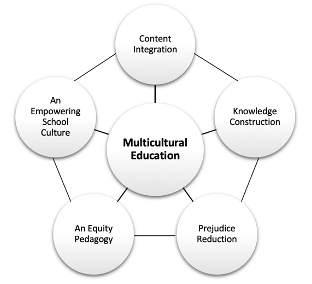
Banks (2009) explains that all five dimensions of multicultural education are equally important; they are interrelated and overlap in some cases.
Content integration emphasises the importance of using a variety of teaching materials from various cultures and introducing key concepts and theories developed in different cultures. According to Banks, knowledge construction “describes teaching activities that help students to understand, investigate, and determine how the implicit cultural assumptions, frames of reference, perspectives, and biases of researchers and textbook writers influence the ways in which knowledge is constructed” (p. 16). In other words, knowledge construction encourages critical thinking and triggers active participation and discussions in the classrooms. Prejudice reduction highlights the importance of developing more democratic and positive cultural attitudes. Equity pedagogy’s main goal is to assure that all students have equal opportunities and access to education and receive appropriate educational support. The fifth dimension is an empowering school culture. This focuses on educational institutions as a whole and their obligations to create an environment where every student will experience educational equality and cultural empowerment regardless of ethnic, social or any other status.
Further reading:
- Banks, J. A. (2015). Multicultural education, school reform, and educational equality. Opening the doors to opportunity for all: Setting a research agenda for the future, 54-63.
- Cho, H. (2017). Navigating the Meanings of Social Justice, Teaching for Social Justice, and Multicultural Education. International Journal of Multicultural Education, 19(2), 1–19.
Watch interview with James Banks
References:
Banks, J. A. (2009). Multicultural education: Dimensions and paradigms. In J. A. Banks (Ed.), The Routledge International Companion to Multicultural Education (pp. 9-32). Routledge.
Banks, J. A. (2016). Multicultural education: Characteristics and goals. In J. A. Banks & C. A. M. Banks (Eds.), Multicultural Education: Issues and Perspectives (9th ed., pp. 2-23). John Wiley & Sons.
Holmen, A. (2014). ”Being bilingual means being a foreigner”. Categorizing linguistic diversity among students in Danish higher education. HERMES-Journal of Language and Communication in Business, 27(53), 11-24.
Nieto, S. (2010). The light in their eyes: Creating multicultural learning communities. Teachers College Press.
Parekh, B. (2006). Rethinking multiculturalism: Cultural diversity and political theory (2nd ed.). Palgrave Macmillan.
 Artëm Ingmar Benediktsson
Leave a comment